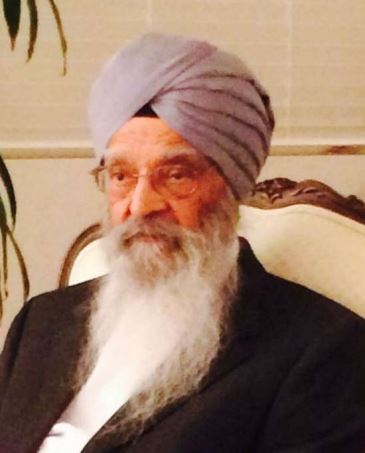
Professor Dr. Ranbir Singh Sandhu: An Exemplary Life
January 20, 1929 – September 26, 2026
Professor Dr. Ranbir Singh Sandhu was born in British-occupied Lyallpur, Punjab, on January 20, 1929, the seventh of eight children to Sardar Pratab Singh Sandhu and Sardarni Harnam Kaur Sandhu (Bajwa). He was a curious, precocious child and would tag along to school with his big sister. He started kindergarten in Mianwali and finished high school in Hoshiarpur. His love for learning was insatiable; he became trilingual in primary school, speaking Punjabi at home, Urdu at school, and Sanskrit after hours with a teacher who noticed how bright he was. He later learned Hindi, Farsi, English, German, Russian, and Norwegian.
He was a child prodigy with a photographic memory and studied anything he could get his hands on. His father tried to steer him toward a practical career in a country with extremely limited opportunities. Ranbir Singh Sandhu had other ideas. If he couldn’t focus on language and history, he decided to study math and graduated at the tender age of 14. He was told to apply to an engineering college and ‘accidentally’ forgot. His father scrambled to submit his application, and he was accepted into a very exclusive class.
As a teenager in a big city for the first time, he roamed the streets and played cards all night with his new older friends. He was lucky to have a steady influence in his college roommate, his big brother. Used to coming in first in his class, he found that placing third in the first round of exams helped him settle down and focus (mostly). He still kept active in India’s struggle for freedom, attended rallies, and gave speeches. He learned a little about surveillance when police brought him to the station, and the inspector revealed the ‘leader’ of his movement was one of the police’s own spies.
He graduated in 1946 with a BA in mathematics from the University of Punjab, and he was a sophomore at Punjab Engineering College in Lahore when the Punjab Partition disrupted his life. He was beaten and taken for dead while seeking protection for his classmates. He was in the back of a cart loaded with dead bodies when a granthi from the local gurdwara noticed him moving, and he woke up in the hospital with his high school classmate, now a medical student, looking at him. He and his elder brother left Lahore and came home to Hoshiarpur.
The Engineering College had no home, was renamed Refugee College, and was housed in Roorkee, in a neighboring state. Refugee College eventually became Punjab Engineering College. Despite multiple illnesses and hardships, he graduated first in his class and was the state’s top-scoring graduate in 1949.
Early in his career, he was known for his hard work, creative problem-solving, and insatiable drive to learn everything. He joined the irrigation department and rose to help design and build Bhakra Dam, the world’s largest concrete gravity dam at the time. He read every journal, hung out with the technical and construction staff, learned geology, soils, and construction methods, and soon became the answer man whenever there was an issue.
Two seminal events marked his life: his revered father’s death in 1953 and his marriage to Surinder Kaur Sarkaria in 1957.
The death of his father when he was 24 had left a huge void, and he was now the sole support of his family: his mother, youngest sister, and hero older brother, whom he roomed with in college, who was critically ill. He asked for leave or a transfer but was denied, so he resigned and moved. He was willing to sacrifice a promising career, status, and a significant salary to take any low-level position. He had built such a reputation that his company sent a senior executive (two levels above his immediate supervisor) to his home and made accommodations that let him care for his family.
Marriage transformed him. He credited his new bride with two major feats: ‘she civilized me and re-introduced me to my faith’. She was also his biggest fan, best friend, and unshakeable support. People often remarked that they’d never seen a married couple so in sync. In nearly every photo, he has his arm around his wife, and his love and admiration are clear. One family member mentioned that they never quarreled. When his wife was brought to the ICU just before her passing, the doctor asked him what made their marriage so successful. His answer was simple: ‘I love her’. He later revealed they had fallen asleep holding hands every night since their wedding. She was his rock, his one and only.
His drive to learn led him to Sheffield, England, to pursue his master’s degree (1960-1962) on a Commonwealth Scholarship, one of only three engineers selected in the entire country. On returning to Punjab, he and his wife suffered a devastating blow in the loss of their second child, and he decided to stay closer to expert medical care in Delhi. He requested a different assignment and looked into teaching. He impressed the selection committee so much that they chose a Master’s Graduate over several other PhDs that were interviewed for the position. He would need a PhD to continue teaching. He had corresponded with Dr. Zienkiewicz in Wales since his days at Sheffield. Prof. Zienkiewicz recommended UC Berkeley, then the world’s premier structural engineering institution. He would argue it still is.
Ever the confident optimist, he applied and started his PhD program in 1965. When he arrived on campus, a professor invited him to dinner. He was excited until they told him who it was. This was the professor whose paper he had publicly rejected with a published rebuttal. He was mentally preparing to be kicked out of the program when the professor complimented him, saying, “I like people who think.”
Again, he was the top of his class. When the university halved scholarship funding, he told the chair, Prof Carlson, that he would have to leave the University. Prof Carlson told him, “I can’t lose my best student,” and found the resources. He had two advisors, Prof Wilson and Prof Clough. However, Professor Pister requested to be his advisor. This was such an honor that Prof Wilson told him he would resign because ‘Pister doesn’t take just anybody, and he’s asked for you’. The University allowed him to keep all three. Thus began a long, fruitful professional relationship with Cal Engineering, especially with Professor Pister.
On graduation in 1968, he joined Harza Engineering in Chicago as a specialist in Dams and the Finite Element method. Once, during a meeting with another consulting company, their representative kept mentioning that they would design using Sandhu’s method; the Harza VP turned to a colleague and asked, ‘Is that OUR Sandhu?’ Harza began to realize what an edge they had. When he left to pursue his dream of research and teaching, people asked what they could do to keep him, but he was driven to follow his own path.
When he joined Ohio State University in 1969, where he taught until 1995, people quickly noted his skills and intellect. His thirst for knowledge only grew. He audited classes in the Math Department, Mechanical Engineering/Engineering Mechanics, and various other fields. The professors in those departments also came to know him well. His research flourished. He won research awards, including a Fulbright Fellowship. He was a visiting scientist in multiple countries, including Norway and Germany. He co-chaired a Teach the Professors conference in Europe. He was a guest scientist at Bell Labs and consulted with numerous clients, including the US Army Corps of Engineers, the US Air Force, and Dames & Moore, among others.
He always focused on his students, whom he regarded as his own children. He innovated by introducing undergraduate coursework previously reserved for graduate students, making his graduates in demand and commanding higher salaries. He introduced them to research fellowships and summer programs, took them to conferences, and encouraged and helped them into graduate school. Committed to equality, he championed his female students and colleagues and worked with Vice Provost Ralph W. Hale to institute a mentoring program for minority undergraduates. His students’ success and the McQuigg Award for distinguished teaching rewarded his efforts. He inspired a student, Tom Irvine, so much that Irvine established an endowment in his professor’s name.
He loved teaching so much that people teased him for speaking only in 48-minute increments (the length of a class at Ohio State). His children endured many lectures on eigenvalues, tensors, matrices, operators, non-conforming materials, and more on rides to and from school in elementary and junior high school.
Faith was always on his mind and shaped his personal conduct, sense of social justice, and civic responsibility. He recounted seeing Bobby Kennedy and Rev. Martin Luther King, Jr. on the steps of Sproul Hall at UC Berkeley. He refused to buy grapes to support farmworkers or South African products long before the divestment push.
He never met a stranger, and the home he and his wife made was always welcoming of family, friends, and friends in the making. They took people in, made them family, and helped them recognize their talents and strengths and become successes in life; they took in stranded travelers; gave guidance and a safe landing to immigrants and students; and generally paid it forward, as their own families had before them.
He is also renowned for his personal journey as a Sikh. He has been an active, well-respected, and valued authority on the Sikh Faith since 1965, when he came to the USA as a doctoral student. Over the years, he has inspired Sikhs to gather for prayer services and helped them organize into formal groups to establish Sangats (congregations), creating Sikh centers and groups that follow the Rehat guidelines for their organizational standards.
In the 1960s, all Sikh members participated in services and met at people’s homes; the goal was to establish Gurdwaras, Sikh places of worship. As a Berkeley student, he helped found the Sikh Center of the Bay Area. The Sikh Center later established the first Gurdwara Sahib in the San Francisco Bay Area in El Sobrante. After moving to Chicago, he helped found the first Gurdwara in the Chicago area, in Palatine, with just 4 families, actively determining, planning, and raising funds to build it. Since the 1980s, he has focused on studying Baani, human and religious rights, and interfaith communication and outreach.
Dr. Sandhu continuously sought resources to deepen his understanding of the Sikh faith and history. He and his wife read deeply, shared notes, and sought opportunities to discuss interpretations with Sikh elders, scholars, and academics. They researched and studied texts regarding old Punjabi and other ancient languages. He had been formally trained in Sanskrit, Urdu, Hindi, English, Russian, and German. He taught himself Punjabi because the British banned it. This facility with language, along with having lived, studied, researched, taught, and lectured in England, the USA, and many European countries, enabled him to translate and explain Baani with a unique facility.
As people recognized his strong understanding and ability to explain the Message and concepts of Baani, they often called on him to share his knowledge with Sangats across the country. He began writing down the most common explanations and translations and created handouts, pamphlets, and brochures. These led to requests from interfaith and religious study groups and organizations. His work with interfaith organizations was wide-ranging. He was a member of the Interfaith Association of Central Ohio and served as president in 1997 and 1998. In 2003, he wrote the chapter “The Sikh Faith” in Religion in Ohio: Profiles of Faith Communities, in commemoration of the state’s bicentennial.
He cofounded several organizations with like-minded Sikhs, including the Sikh Religious and Educational Trust (SRET), the Sikh Educational and Religious Foundation (SERF), and the Sikh Council for Interfaith Relations (SCIR), and in the process, built one of the largest Sikh reference libraries. One of his greatest roles was as the founding Secretary General of the World Sikh Council – America Region (WSC-AR).
Before his daughter’s marriage in 1981, he realized that Ohio did not legally recognize a Sikh marriage by religious officials. So, the Anand Karaj wedding was performed as a full worship service before a congregation, and the state recognized this congregational marriage. He also advocated tirelessly with decision-makers and clergy in the armed forces to restore Sikhs’ right to maintain their articles of faith while serving their country.
He is perhaps best remembered for a seminal, years-long research study: Struggle for Justice. The foreword condenses the story of State repression, persecution, and genocide of the Sikh people in India. The second section includes translations of speeches by Sant Jarnail Singh Bhindranwale, taken from actual recordings.
He was multidimensional. He introduced his children to literature, history, science, and politics. He made every subject fascinating. He could quote Shakespeare and give a dissertation on the true villain in Thomas Hardy’s Tess of the D’Urbervilles. Then he would turn around and play word games or show how different materials created different flame colors. The man who couldn’t cook and claimed he would burn water if asked to boil it for tea learned to make quesadillas after marriage. He had a great teacher in his wife.
Dr. Sandhu was warm, engaging, funny, and a great storyteller. He always saw the good in people and drew kids in like a magnet. He had a special soft spot for his nieces and nephews. He got along with everyone and joked that he should become a Walmart greeter. Wealth, power, and status never impressed him, but character did.
Dr. Sandhu lived an amazing life, lived it on his own terms, and left it on his own terms. He loved all humanity as his own, and he lived his faith.
His wife and son, Dr. Gurpal Singh Sandhu, predeceased him, and he loved and devoted himself to both. His community remembers him as a moral man of great talent, drive, ingenuity, and compassion. His family remembers him as a doting grandfather and beloved uncle. He is truly missed.
To send flowers to the family or place a tree in memory of Ranbir Singh Sandhu, please visit our Tribute Store.

 Send Flowers

 6 trees were planted in memory of Ranbir Sandhu
 Anonymous
left a message on October 9, 2026:
 Arjan Kahlon
left a message on October 16, 2026:
 Arun Mirchandani
left a message on October 16, 2026: