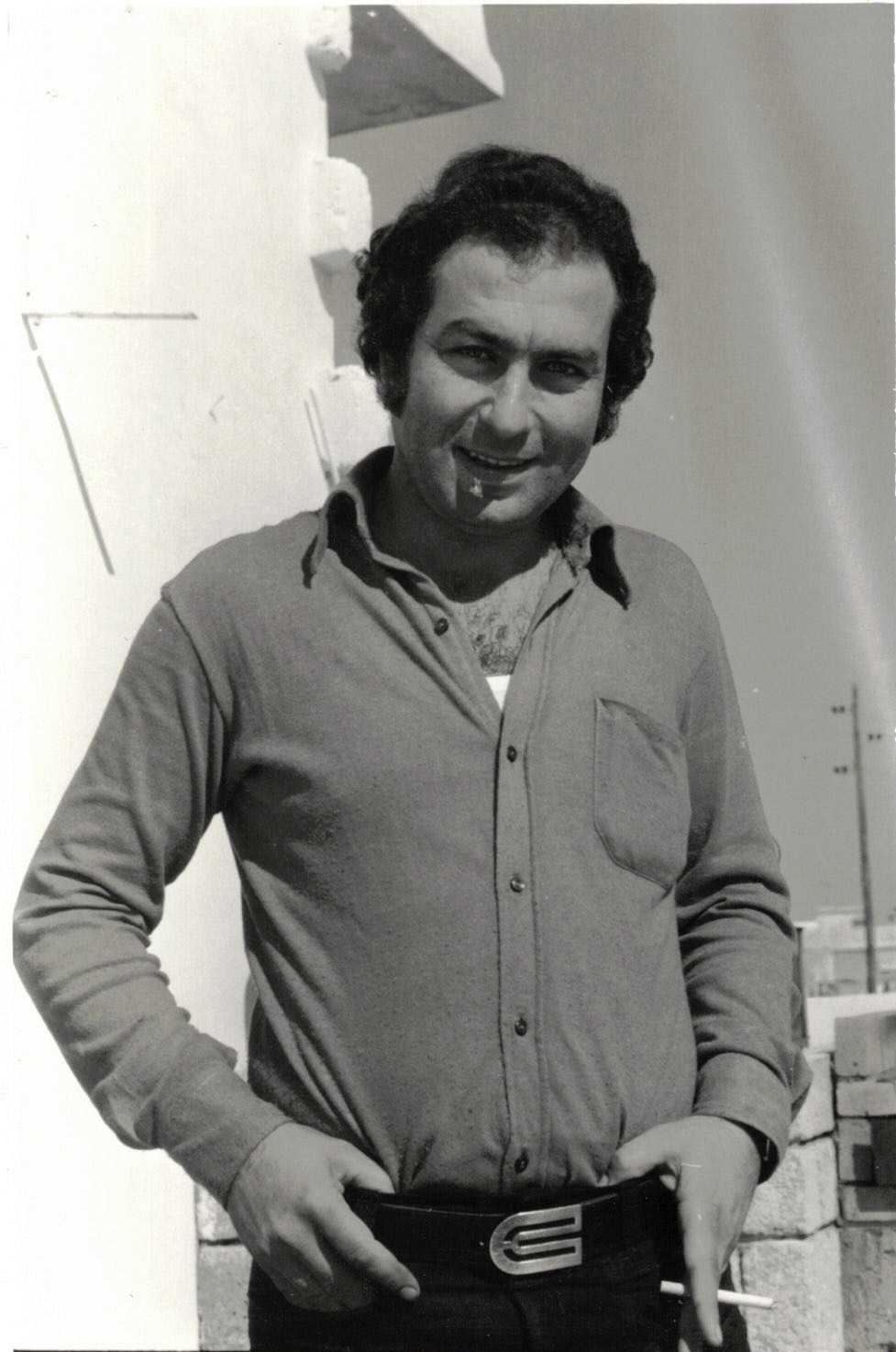
Pierre was born in Beirut, Lebanon, in 1941 to Michel Rizk Bikai and Wardeh Francis, the fifth of seven children. He attended the Patriarchal College. From 1967 to 1976, he worked for the Department of Antiquities of Lebanon as field manager of the excavation at Tyre. Work carried out in this context included: excavation of the Roman Necropolis, excavation and restoration of two medieval churches, excavation of hundreds of Roman, Byzantine and Phoenician burials in Tyre and the area, excavation of a Persian temple, salvage work at a Neolithic site, and excavation of one of the largest hippodromes in the roman Empire. Additionally, he supervised the restoration and preservation of frescoes, mosaics and other objects at the site and supervised the construction of the Tyre Museum. Other work included: hiring of workmen, preparation of salaries, supervision of draftsmen and surveyors, public relations and, in general, supervising up to 500 employees. From 1969 to 1974, he was the architect of the University of Pennsylvania excavation at Sarafand, Lebanon.
In 1972, he married Patricia Maynor Bikai in a church that she had excavated in Tyre.
In 1974, Pierre trained at the American Institute of Nautical Archaeology excavation (of a Roman ship lying 160 feet deep) at Yassi Ada, Turkey. By 1976, he and Patricia had moved to the United States where in 1978 he earned a B.A. in Anthropology and Near Eastern Studies (double major) at the University of California, Berkeley, with honors. He went on to earn an M.A. (1980) and a Ph.D. (1991) in Near Eastern Studies (Archaeology) also from Berkeley. His dissertation was “The Cedar of Lebanon: Archaeological and Dendrochronological Perspectives.”
In 1981, he was architect and archaeologist of the U. of California/Brigham Young U. expedition to the Seila Pyramid, Egypt. In 1985, he and Patricia explored the island of Corvu in the Azores for the possibility of Phoenicians landing there. He collected samples of the Cedar of Lebanon in Lebanon, Syria and Cyprus in 1986. Beginning the next year, he was archaeologist and chief architect for the U. of California excavation at Nineveh, Iraq.
From 1991 to 2006, Pierre was the director of the American Center of Oriental Research in Amman, Jordan. In this capacity, he directed major archaeological, conservation and tourism development projects at sites in Jordan, including the World Heritage site of Petra, the Amman Citadel, and Madaba; directed a U.S. non-profit research institution and assisted 30 resident researchers per year, ca. 1200 other students, and 25-30 university archaeological projects; oversaw a center with a 25,000-volume library, a conservation laboratory, and 80-bed residential facility. He raised approximately $1 million a year in each of the 15 years he was there.
Simultaneously, he was the director of the St. George’s Church Excavation in Amman and of the Black Desert, Rajl Project, which documented the inscribed stones of an area of the Jordanian desert.
For his work in Jordan, he received the Abdul Hameed Shoman Foundation (Arab Bank) Award; the Richard J. Scheuer Medal and the W.F. Albright Service Award from the American Schools of Oriental Research; and the Distinguished Service Medal from ACOR. The Independence Medal, 2nd degree, was awarded by H.M. King Abdullah al-Hussein in 2006.
“When I saw him [in April 2026], although he had life to live, I saw in his eyes his soul was fulfilled. His body was on earth, but his heart was with Patricia in heaven. God has them together in his garden now, excavating for eternity.” –Justin Chamoun, Pierre’s Grand Nephew
Rajil: The Cairn of the Mermaids, Studies in the History and Archaeology of Jordan 10 (2009): 225-43.
Conservation and Preservation of Archaeological Sites in Jordan: Archaeology Initiatives of the American Center of Oriental Research. In Crossing Jordan: North American Contributions to the Archaeology of Jordan, ed. T. E. Levy, P. M. M. Daviau, R. W. Younker and M. Shaer London: Equinox, 2007, 87-94.
A Thamudic E Text from Madaba (with Fawwaz al-Khraysheh), Annual of the Department of Antiquities of Jordan 46 (2002): 215-24.
The Cedar of Lebanon: Textual Evidence for the Sources. Archaeology and History in Lebanon 14 (2001): 50-57.
Ishtar (the cedar-tree) and Gilgamesh the Loser. Archaeology and History in Lebanon 14 (2001): 14-23.
University of Jordan Excavations at Khirbet Salameh 1993, Annual of the Department of Antiquities of Jordan 38: 395-99.
The Byzantine Church at Darat al Funun (with May Sha’er and Brian Fitzgerald), Amman, 1994.
Khirbet Salameh 1992, Annual of the Department of Antiquities of Jordan 37: 521-29.
The Land of Tyre and History of Excavations, pp. 13-35 in The Heritage of Tyre, ed. M. S. Joukowsky, Dubuque, 1992.
A Phoenician Fable (with Patricia M. Bikai), Archaeology (Jan./Feb. 1990): 20 ff.
Tyre at the End of the Twentieth Century (with Patricia M. Bikai), Berytus 35 (1988): 67-96.
A Report of the Monuments of Tyre and the South Lebanon, UNESCO, Paris, 1987.
The Archaeology of Tyre, a presentation for the General Assembly of UNESCO, Paris, 1980.
A Report to the Government of Portugal on Archaeological Remains at Corvu, Azores, 1979.

 Send Flowers